
Pressure washer rentals: how much power does each job need
Pressure is measured in bar or psi (pounds per square inch). One bar equals about 14.5 psi. Common domestic models, such as the Bosch AQT 37 or Karcher K5, deliver between 100 and 140 bar (1,450 to 2,000 psi) — enough for a concrete driveway, a rendered wall or a car. More powerful models reach 160 or 200 bar and make sense when grime has built up over years.
For most household jobs around Itajaí — washing a driveway covered in red clay after heavy rain, removing algae from a garden wall or hosing down iron gates — 120 bar gets the work done in an afternoon. Extra power only pays off when dirt is deeply ingrained or the area is very large.
Nozzles and hose: the kit that makes the difference
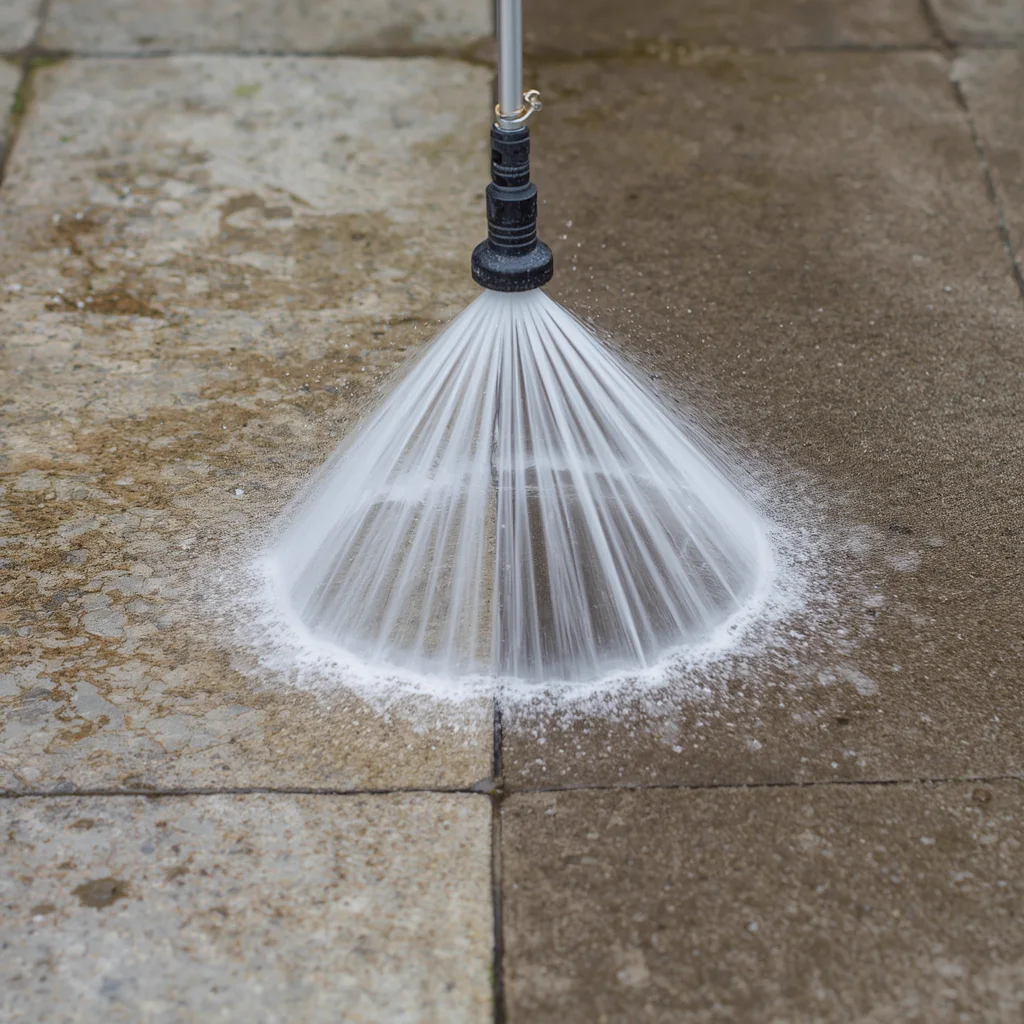
Pressure washers come with at least two or three interchangeable nozzles. The 0-degree nozzle fires a pencil-thin jet useful for stubborn stains on concrete, but it would gouge timber or plastic. The 25-degree nozzle is the most versatile choice for driveways and walls. The 40-degree nozzle spreads the jet wider and is the right pick for cars, glass and surfaces that cannot take direct impact.
The high-pressure hose is usually between five and eight metres long. If the water point is far from the job, ask in the chat whether the owner has an extra garden hose — a standard 20-metre hose connected to the machine's inlet solves the distance problem without any loss of pressure, because what enters the pump is ordinary tap water.
Driveway and wall: how to clean without damaging the grout
On a concrete or cement driveway, hold the 25-degree nozzle about 20 centimetres from the surface and work in overlapping passes. Results show fast: algae and mud lift in minutes. On a wall with fresh paint and intact grout, the same technique works well. On a wall with flaking paint or loose grout, pull the nozzle back to about 35 centimetres and never use the 0-degree tip — it strips away anything that is already letting go.
Car and deck: lower pressure, greater distance
To wash a car, keep the 40-degree nozzle at least 40 centimetres from the bodywork. Keep the jet away from windscreen wiper rubbers and door-gap seals — high-pressure water forces its way through seals not designed for it. A foam nozzle, when listed in the rental ad, speeds up the job and saves water.
A timber deck needs more care. Hardwoods such as cumaru or ipê can take a 25-degree nozzle at 30 centimetres, always moving with the grain. Softer woods like pine or cedar are more porous: use the 40-degree nozzle, stay 50 centimetres back and make a single pass. Stopping the jet on one spot for more than two seconds leaves white stripes.
What not to wash with a pressure washer
Flaking paint is the most common source of trouble. If the paint is already peeling, the washer will take more of it off — the cleaning job turns into accidental stripping. The same goes for windows with old seals or thin timber window frames: the jet pushes water inside.
Avoid external electrical panels, light fittings without adequate IP protection and fibre-cement roof sheets with loose screws. A window air-conditioning unit can be rinsed on the outside with the 40-degree nozzle from a distance, but never aim the jet at the fins from inside.
- Flaking or peeling paint on walls
- Windows with worn seals or thin timber frames
- Outdoor electrical panels and light fittings without IP protection
- Fibre-cement roof sheets with loose screws
- Soft-wood decking (pine, cedar) with a 0-degree or 15-degree nozzle
Return it clean: the checklist before handing back
Leave the machine running with the water on for thirty seconds after switching off to flush the pump internally. Remove each nozzle and rinse it. Clean the inlet filter screen — it usually sits on the suction hose or at the pump inlet. Clay in the filter reduces pressure and is the first thing owners check. Coil the high-pressure hose without sharp kinks and pack all nozzles back into the case.
Photograph all accessories before pick-up and again after cleaning — the Alugoae chat is the right place to log both sets of pictures. With everything documented, the return is quick and the deposit comes back without dispute.
- Run the machine for 30 seconds after switching off
- Rinse each nozzle individually
- Clean the inlet filter screen
- Coil the hose without kinks
- Pack all nozzles in the case or original bag
- Photograph the accessories before returning
Frequently asked questions
What is the difference between bar and psi in a pressure washer?
Bar and psi measure the same thing — the force of the water jet. One bar equals roughly 14.5 psi. A 140-bar model produces around 2,000 psi, which is enough for most home jobs.
Can I wash my entire car with a rental pressure washer?
Yes, but use the 40-degree nozzle at least 40 centimetres from the bodywork. Avoid door-gap seals, windscreen wiper rubbers and power-folding wing mirrors.
How long does it take to pressure-wash a 30-square-metre driveway in Itajaí?
With a 120-bar model, a concrete driveway without heavy algae is done in 20 to 30 minutes. Heavy build-up can take twice as long.
Browse pressure washers available near you in Itajaí and Balneário Camboriú and book through the app.